The rising number of suicide cases among PhD students in recent years has raised serious concerns about stress and mental health in academia. One of the biggest contributors to this stress is poor time management. The constant pressure to meet deadlines while juggling research, writing, and personal life can lead to burnout and anxiety. When time is not managed effectively, it can feel like an endless cycle of unproductive work and overwhelming expectations.
During my PhD, I realized that managing time well is not about working longer hours, but also it is about working smarter. In this blog, I will share some practical time management techniques that helped me stay productive while maintaining a healthy balance between my academic work and personal life.
1. The Pomodoro Technique: Staying Focused During Long Research Hours
As a PhD researcher, you often have hours of deep focus work. It could be reading articles, analysing data, or writing your reports and dissertation. I used to find it very difficult to maintain focus for extended periods without feeling exhausted. I found the Pomodoro Technique very useful, which includes working for 25 minutes, then taking a 5-minute break, and after four “Pomodoros” (work intervals), taking a longer break (15-30 minutes). In the figure, the technique has been explained using a schematic given flow chart 1.
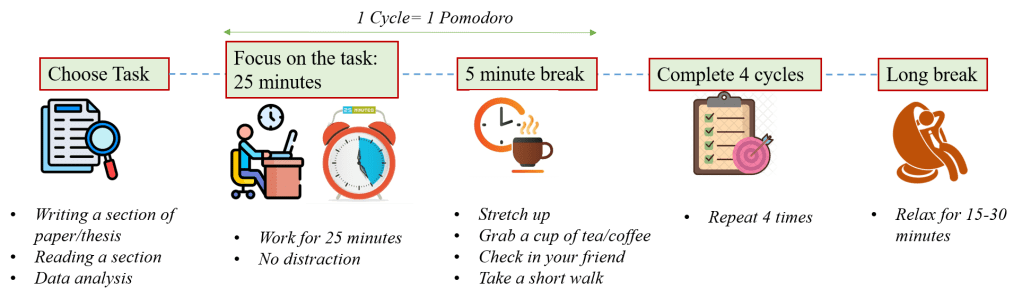
This technique helped me avoid distractions, improved my concentration, and made long work sessions feel more manageable. In addition, the frequent breaks kept me from feeling drained.
2. The Eisenhower Matrix: Prioritizing Urgent vs. Important Tasks
PhD research often involves tasks that seem equally urgent: writing, data collection, meetings, and conference submissions. The Eisenhower Matrix helped me decide what truly matters and what can wait by sorting my tasks based on urgency and importance.
- Urgent & Important: Immediate deadlines
- Not Urgent but Important: Long-term goals
- Urgent but Not Important: These tasks can be delegated or handled quickly
- Not Urgent & Not Important: Tasks that do not contribute to my research (distractions)
I have tried to divide the tasks of a PhD researcher into these four quadrants in Figure 2. These quadrants can be personalized according to your plans/research activities.
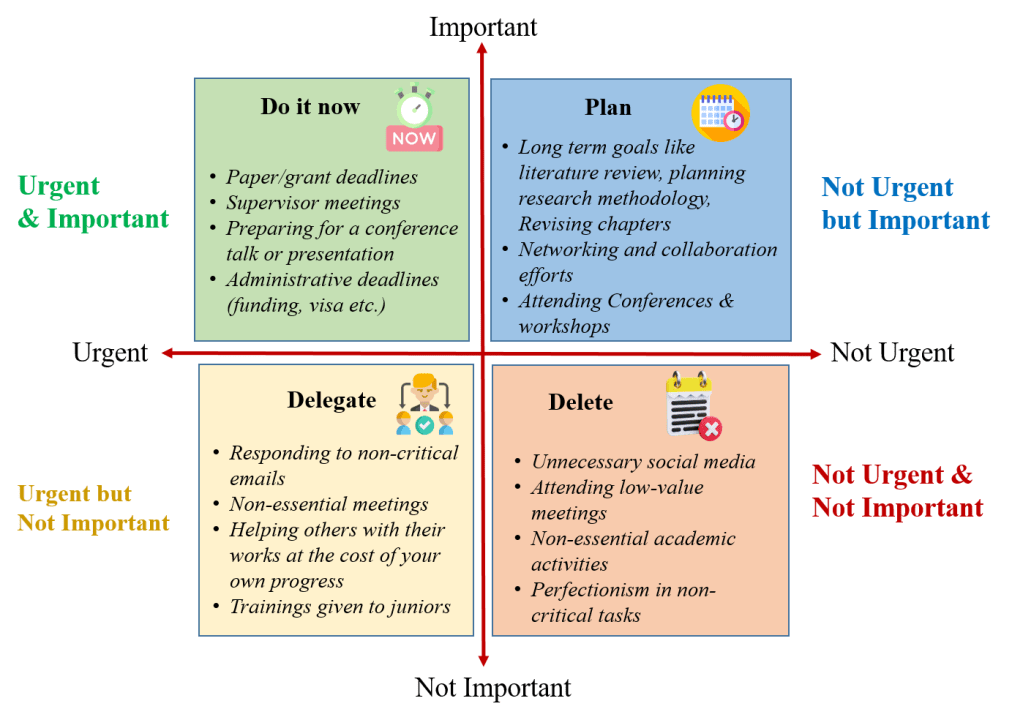
I spent most of my time in Quadrant 2 (important but not urgent) to plan, schedule, and complete long-term tasks, for example, conducting a thorough literature review, planning research methodology, performing trials, analysing results, and writing. Spending most of my time on long-term tasks prevented last-minute stress. For Quadrant 3, if possible, some tasks can be delegated to lab technicians (if available), and only limited time should be spent on these activities. The activities in Quadrant 4 are distractions that must be ruthlessly eliminated.
3. Time Blocking: Structuring Your Day for Maximum Productivity
With so many things to juggle (meetings with advisors, reading papers, collecting data, and writing chapters), it is easy for tasks to overlap, and deadlines can sneak up on you. Time blocking helped me create structure in my chaotic PhD life. I used this technique to manage my PhD research in the following ways:
- Schedule dedicated time for each task: Each block has a clear goal, whether it is writing 500 words, analysing data, or preparing for a meeting. For example, I might set aside 9 AM to 12 PM for experimental work, then allocate 3 PM to 5 PM for writing or preparing a presentation.
- Adjust time blocks based on workload: On days with long experiments (8 AM – 5 PM, as my study was sunshine-dependent), I used gaps in between to work on computer simulations.
- Prioritize self-care: I also blocked time for non-work activities such as exercising and Zumba in the evening. Researchers must set aside time for their hobbies, gym workouts, sports, or any activity they enjoy. Research can be all consuming, therefore, prioritizing self-care and personal commitments by scheduling breaks and family time is a must.
By committing to specific tasks at designated times, I noticed that I wasted less time figuring out what to do next. This approach helped me avoid procrastination and make steady progress without feeling overwhelmed.
4. Time Auditing: Tracking and Adjusting Your Schedule
At the start of my PhD, I was good at making to-do lists but never tracked whether I was actually using my time wisely. That changed when I learned about Time Auditing, which involves tracking how I spent my time versus what I had planned.
I realized I was setting too many goals per day, making me feel overburdened. Therefore, I started setting targets that are more realistic.
In addition, managing your to-do list according to your energy levels can give better results. Identify when your energy levels are high, moderate, and low throughout the day. You can divide your tasks accordingly, as shown in the given flowchart 3.
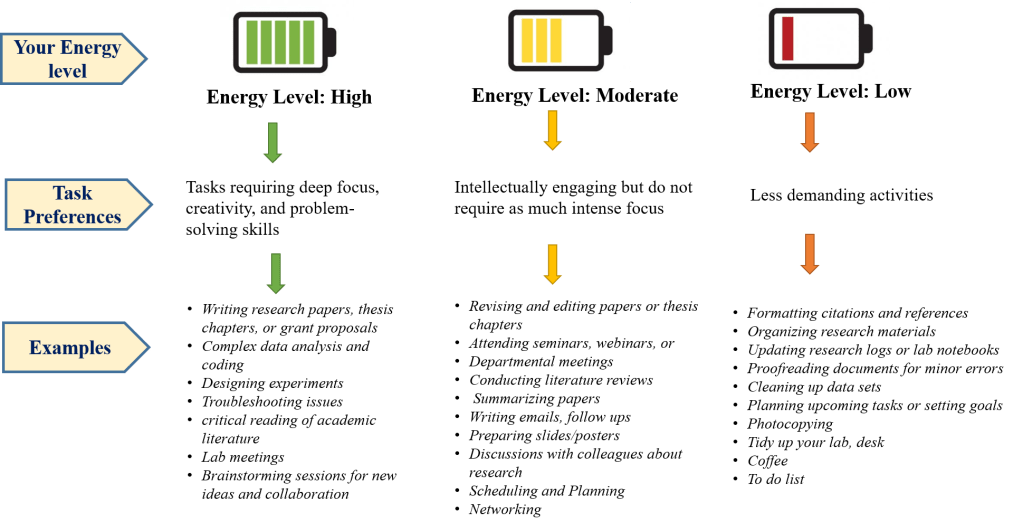
I used this approach to segregate my daily activities according to my energy level in the following way:
- Morning (high energy): Experiments, calculations, writing
- Afternoon slump (low energy): Emails, administrative work, online courses, lab management, cleaning, and organizing the workspace
- Evening: Exercise, hobbies, relaxation
This approach helped me optimize my productivity without feeling exhausted.
5. Tools & Apps for Time Management
In today’s digital age, managing time without the right tools is like sailing without a map. There are many tools available to track progress. I generally used Google/Outlook Calendar and planners.
- Google/Outlook Calendar: I blocked time on Google Calendar for deep work, meetings, and breaks. It helped me stick to my time blocks and avoid overcommitting.
- Trello: You can use Trello to track the research progress. Creating boards for different projects and breaking tasks into smaller steps helps to visualize the workload.
Having everything in one place helped me avoid missing deadlines and kept my tasks structured.
What Results You Can Expect
Managing time as a PhD researcher often feels like an endless balancing act. However, by using techniques like the Pomodoro Technique, the Eisenhower Matrix, Time Blocking, and Time Auditing, I learned to work more efficiently and reduce stress.
These strategies helped me push through procrastination, stay on top of deadlines, and maintain motivation. Most importantly, I learned to celebrate small wins—finishing a section, solving a tricky problem, or hitting a milestone. Acknowledging progress kept me going through tough times.
I encourage fellow PhD researchers to try these methods and find what works best for them. With the right approach, you can not only finish your research but also enjoy the journey.

 Science Edge Zone
Leave a comment